Indonesia’s textile and garment industry, one of Southeast Asia’s most resilient manufacturing sectors, is showing renewed dynamism and increasingly attractive opportunities for foreign investors. As of mid-2025, the sector stands as a cornerstone of the national economy, contributing around 5.8% to GDP and employing over 4 million workers—a testament to its importance both domestically and globally.
A Market on the Move
Indonesia’s textile market, currently valued at approximately USD 13.8 billion, is forecast to surpass USD 22 billion by 2033, with a projected CAGR of 5–5.6%. The country remains a top global exporter, shipping products to major markets including the United States, Japan, the European Union, and the Middle East. Key industrial hubs like Bandung, Semarang, and Subang blend traditional craftsmanship with modern production facilities.
But beyond its heritage, Indonesia is positioning itself as a serious player in high-value, sustainable, and technical textiles—offering long-term upside for foreign capital.
Why Indonesia?
-
Cost-Effective Labor: Competitive wages continue to attract manufacturing operations from regions like China and South Asia.
-
Growing Infrastructure: Integrated smart industrial zones such as Subang Smartpolitan now offer direct access to ports, rail lines, and airports.
-
Trade Leverage: Upcoming agreements like the Indonesia-EU CEPA are expected to reduce export barriers and open doors to high-demand markets.
Government Push & Investment Surge
Investment in Indonesia’s textile, apparel, and footwear industries soared to IDR 39.2 trillion (~USD 2.6 billion) in 2024, with apparel alone seeing a 121% year-on-year increase. In 2025, four new companies have already secured permits totaling over IDR 300 billion, with nearly 2,000 jobs projected.
The government has responded by rolling out a suite of investor incentives:
-
Subsidized interest rates for labor-intensive industries
-
Fast-track permits for export-focused firms
-
Import duty exemptions for machinery aligned with Industry 4.0 upgrades
-
Full tax holidays for strategic sectors
The policy momentum is further strengthened by President Prabowo Subianto’s industrial revitalization agenda.
Opportunities for Global Investors
1. Modernization of Machinery
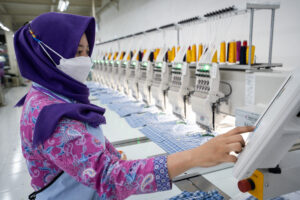
With 70–80% of Indonesia’s textile equipment over two decades old, there is significant room for foreign partners in automation, energy-efficient machinery, and digital production systems.
2. Green and Technical Textiles
Demand for organic, recycled, and high-performance fabrics is rising. Partnerships in R&D, sustainable processing, and value-added production are in high demand.
3. Industrial Real Estate & Eco Zones
New generation industrial parks, particularly in West Java and Batam, offer turn-key facilities, power reliability, and tax advantages. These zones cater specifically to export-oriented industries and foreign investors.
4. Strategic Joint Ventures
Local mid-sized manufacturers seek foreign equity and technology partners to scale their operations and access global supply chains. Many are export-ready and already producing for global brands.
5. Market Access Gateway
Foreign players can tap into Indonesia’s low-cost base while producing under favorable trade terms for Western and regional markets—especially with the EU CEPA on the horizon.
Outlook
Despite challenges such as rising energy costs, illegal textile imports, and outdated machinery, Indonesia is proving its intent to remain competitive on the world stage. The textile industry is evolving fast—toward sustainability, digital transformation, and greater value addition. With the right partnerships and capital inflows, Indonesia could emerge as the region’s next textile powerhouse.
Company Spotlight